What’s next.
Making the future and teaching it. What I learn at the frontier of biological engineering, in the lab and with companies, decides what I teach and how I teach it. Studying whether that works, and taking it to the University, is part of the same job.
What cannot be delegated.
In 2023, when we first visited the El Paraíso Hydroelectric Power Plant, its ecofilter was removing far less hydrogen sulfide than the manufacturer had promised, and the neighbors could still smell it. Finding the cause took us months and demanded things no language model would have done for us: closing mass balances, measuring pH, noticing what was missing from the outlet water, reading a metagenomic analysis and, above all, distrusting the manufacturer’s figure.
I think about that diagnosis a lot when I watch my students with artificial intelligence. They copy and automate more than ever, and the answer heard everywhere is to go back to the fundamentals. I agree, though it remains to say which ones, and cutting-edge work shows that best, because there you can see what a person had to do to solve a real problem.
We call that the non-delegable core.
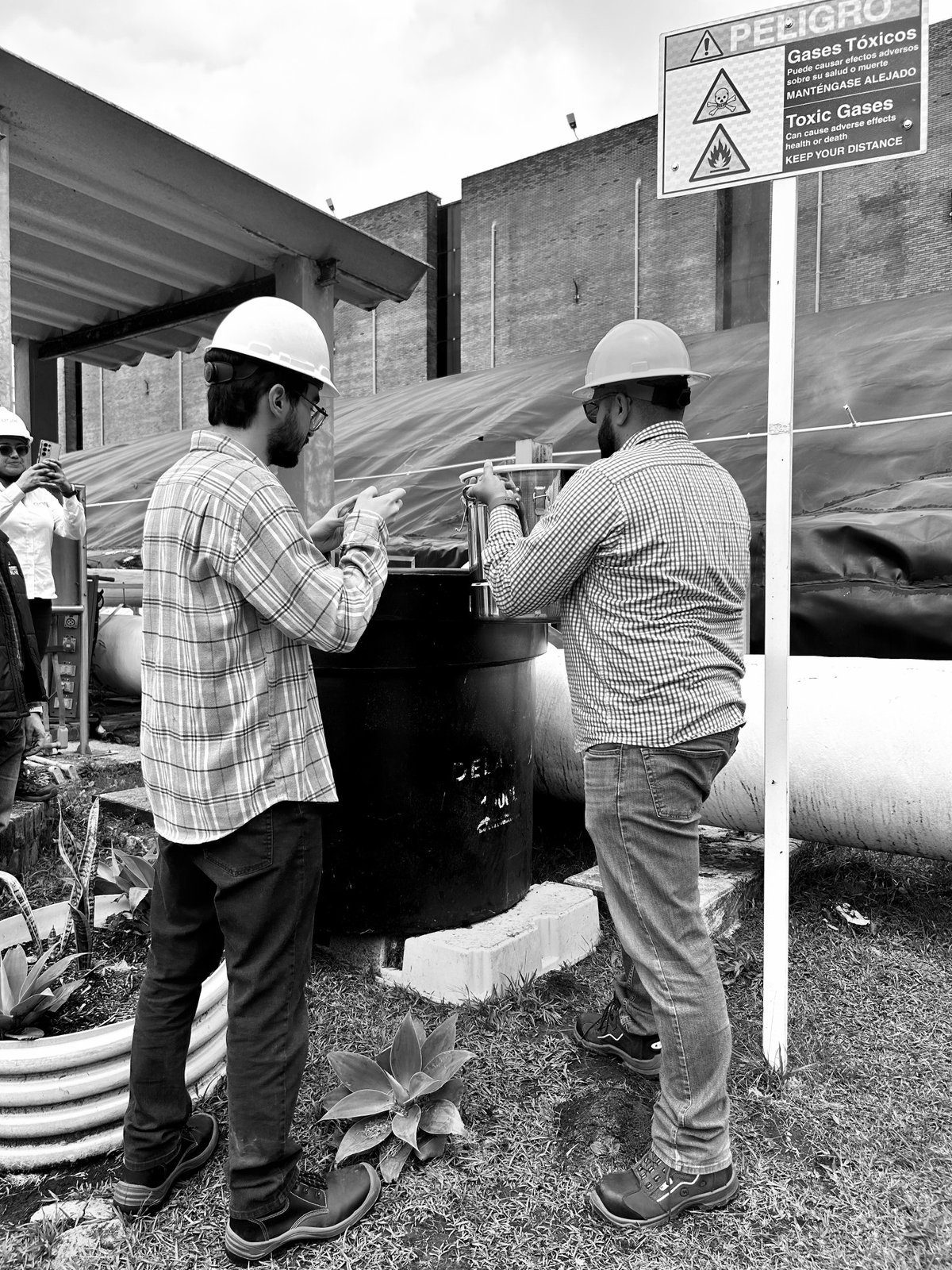
Studying one’s own class makes for a good teacher, but the university’s task is also to make the future, and the future is made through research. That is why my plan starts from research, which will stay at the frontier, in the topics my group already works on: in health, gene therapies, nanoparticles that carry drugs into the cell and peptides against antimicrobial resistance; in food, sensory design and native yeasts; and in environment and energy, the air breathed by the neighbors of a hydroelectric plant and the microorganisms that turn biomass into fuels. I want what I learn there to reach the classroom on purpose, to measure whether it works, and for the University to have a way of doing the same with other professors’ research.
An example: the ecofilter.
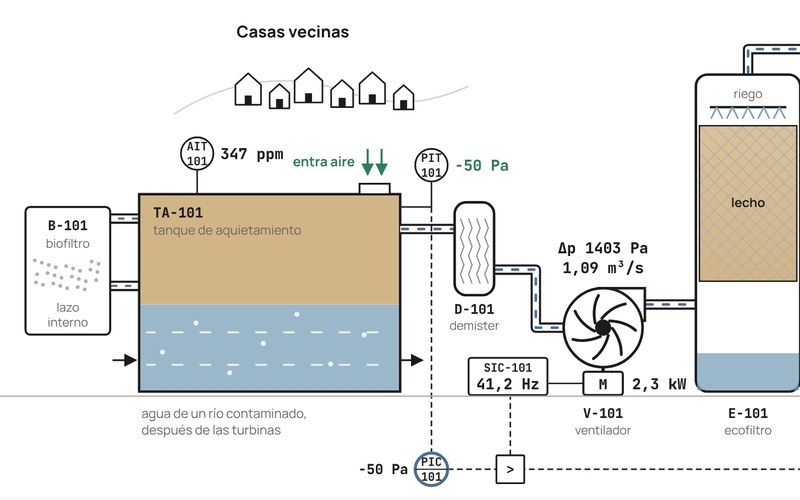
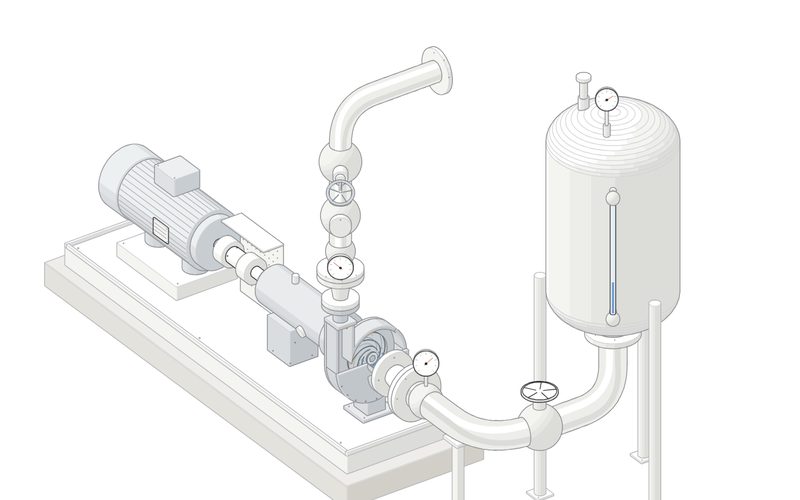
The ecofilter works as an example because it has already started to reach the classroom. In 2024, Mariana García Alba and Esteban Muñoz Cardona mapped the plant’s process flow diagram in their undergraduate project and proposed improvements to the ecofilter. In his master’s, Jesús Rafael Acevedo Mastrogiacomo built a dynamic model of the system and a controller that finds the fans’ optimal operating point on its own, and in 2026-20 a challenge in the Professional Development Project Seminar models with computational fluid dynamics how the gas is distributed in the biofilters. With Jesús Rafael’s model I built a Unit Operations Project simulator that enters the course in 2027-10 as a class activity: students run the ecofilter’s fan while the hydrogen sulfide load changes hour by hour, use the mechanical energy balance to check when the tank lets untreated gas escape, and see why removal drops as the load rises. The step I would like to take now is for them to diagnose a failing unit with it, with an artificial intelligence assistant at their side, and to measure whether those who go through it diagnose a different unit better once the tool is taken away.
2023-2024
At the plant
The ecofilter removed far less than promised, and the neighbors could still smell it.
The case
What cannot be delegated
Closing balances, measuring pH, noticing what was missing, reading a metagenomic analysis and distrusting the manufacturer’s figure.
2024-2026
In the classroom
An undergraduate project, Jesús Rafael’s thesis with its dynamic model, a Seminar challenge and, built on that model, a Unit Operations Project simulator.
Still to do
Measuring it
Diagnosing a failing unit with the simulator and measuring whether students solve another one without the tool.
The same path works for the other lines. In health, Industrial Biotechnology turned in 2023-20 around recombinant proteins, and in the project with the Fundación Santa Fe de Bogotá we learned how hard it is to produce antimicrobial peptides in microorganisms that those same peptides attack. The course’s cases can come from there, from the nanoparticles we designed to carry drugs and genes into the cell, and from vaccine fermentation and scale-up, which several of my students have worked on.
Measuring it.
Bringing the frontier into the classroom only helps if it can be measured, and the evidence is still scarce. None of the eight frameworks competing today to integrate generative artificial intelligence into teaching, ours included, has been validated against learning outcomes, and in chemical engineering there is not a single controlled study on any of its core topics. To the AIGEN network, coordinated by the Monterrey Institute of Technology and Higher Education (Tecnológico de Monterrey) and bringing together 55 universities, we proposed validating CASF 2.0 with three groups.
Three groups, one prediction.
Without artificial intelligence
The control group.
Unrestricted chatbot
It hands over the answer when asked.
CASF 2.0 tutor
It holds back the answer, guides with hints and withdraws help as the student gains competence.
CASF 2.0 tutor = without artificial intelligence > unrestricted chatbot
What is measured is what each student achieves when the tool is taken away, and the prediction is registered before there are data. In this proposal, each course’s non-delegable core comes from a frontier case like the ecofilter. The study has not started yet.
With the Tecnológico de Monterrey and the Pontificia Universidad Católica de Chile, NOVUS Tríada is already under way, comparing feedback from artificial intelligence with feedback from professors, and with colleagues from several universities in the Americas we proposed a project, now under evaluation, that measures how well a student uses an assistant’s help, with a test that can be repeated every time the models change.
Continuing Augmented Intelligence.
I want this not to depend on me alone. In 2024 I co-founded the Augmented Intelligence initiative in the School of Engineering. Its call received 30 proposals from eight departments, put 26 assistants into operation, and taught us that artificial intelligence helps a course when the professor decides where it comes in. I would like to continue it with a harder question: which part of each discipline’s work cannot be delegated to artificial intelligence, according to what each professor sees in their own research or consulting, and how it is taught. Each professor would bring a case from their frontier into their course, write down its non-delegable core and measure it with the CASF 2.0 protocol, with the support of those at the University who research engineering education and evaluate each innovation.
That is what the service I already do is for: the Task Force on Teaching in the Age of AI, which prepares recommendations for the University; the Research Ethics Committee of the School of Engineering, through which the protocols pass; the leadership of the Product and Process Design Group (GDPP), and the Research Committee of the AIGEN network, which I lead. Outside the University, the associations of engineering schools and of chemical engineering programs could take the study to other programs in the country.
The frontier
Research in health, food, environment and energy, and training for organizations: where you can see how an engineer’s work is changing.
The classroom
A case from that frontier turned into a course, like the ecofilter simulator, with its non-delegable core written down.
The evidence
Whether the course works, measured with the CASF 2.0 protocol once the tool is taken away from the student.
What the evidence measures goes back to the frontier and decides the next case.
The University
The continuation of Augmented Intelligence, the Task Force, the committees and the School’s units: that is how the cycle reaches other professors.
A few years from now.
I would like a chemical engineering student at Uniandes to learn to diagnose a failing unit in a simulator built with data from a real plant, with an artificial intelligence assistant at their side, and to know which part of the diagnosis they cannot hand over. I would also like a professor from another department to be able to do the same with their research, because the School would give them a way to do it and to measure it, and for our studies to say with data whether it worked. I put no dates on any of this, because it depends on calls for proposals, on partners and on what the studies show along the way.
The home page also asks that the time artificial intelligence frees up go back to forming the person. That cannot be decreed, and I do not yet know how to make it a habit. I can open spaces, such as a research seedbed, for those who want to spend that time on research, and ask in my courses, in training at scale and in the Task Force what the saved time is spent on.
Where each thing stands.
Under way
- Research in health, food, environment and energy
- AI feedback and professors’ feedback (NOVUS Tríada, 2025-2027)
- The ecofilter simulator, a class activity from 2027-10
Proposed
- CASF 2.0 causal study in the AIGEN network (not started yet)
- Measuring how well a student uses help (under evaluation)
To build
- Diagnosing with the simulator, with an assistant at the student’s side
- The continuation of Augmented Intelligence
- A research seedbed for the time that is freed up
- A site in each chemical engineering program that wants to join
What I commit to.
Bring frontier cases into my courses, each with its non-delegable core written down and measured.
Register studies before there are data, and publish the results even when they do not confirm what we expected.
Propose to the School the continuation of Augmented Intelligence.