Augmented Intelligence.
The School of Engineering’s initiative, from 2024 to 2026, to bring generative AI into its courses.
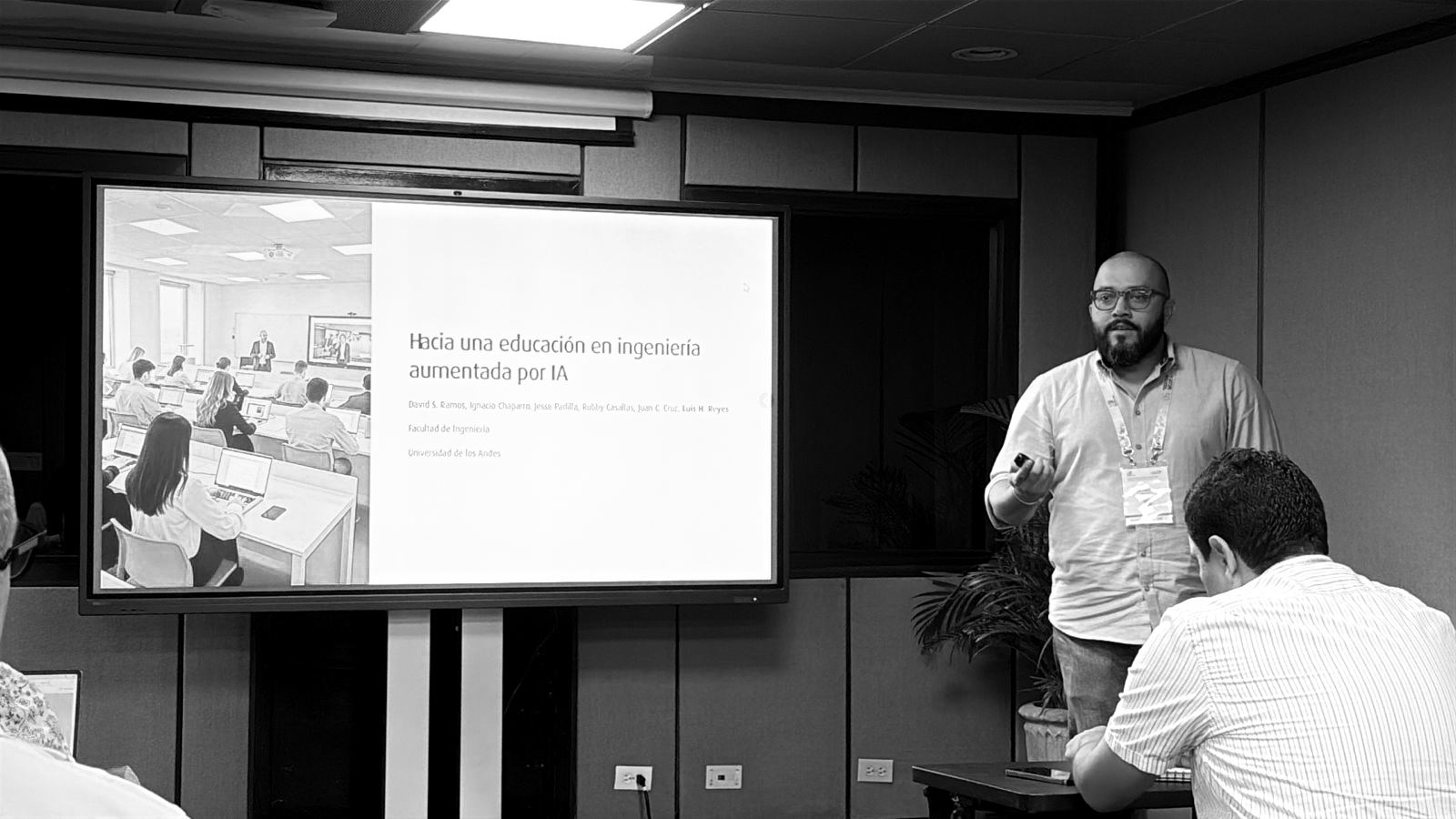
The first call, 2025-1
The proposals came from eight departments of the School.
The most used assistants were those whose professors built them into their class and let us into the classroom to present them. The call also showed its limits: use concentrated around the presentation and fell over the weeks, and several assistants were barely used. We documented this in the closing report, together with what we would do differently, and it is part of what we are now taking to our research on generative AI in engineering education.
| Category | Proposals |
|---|---|
| Process optimization | 15 |
| Contribution to learning | 11 |
| Skills enhancement | 4 |
OpenAI’s Global Faculty AI Project
In 2025, my work on AI in engineering education was recognized through selection into OpenAI’s inaugural Global Faculty AI Project, chosen from more than 300 applications. The selection validates our approach at Uniandes and connects our local initiative to a global network of innovators.
My role in the initiative
As a co-founder of the Augmented Intelligence Uniandes initiative, alongside Dean Rubby Casallas and Professor Juan Carlos Cruz, I took an active part in the strategic integration of generative artificial intelligence in the School of Engineering at Universidad de los Andes. The initiative, launched in June 2024 and closed in the second semester of 2026, marked a shift in how we conceive teaching and learning in engineering.
Leadership and conceptual design
- Co-creator of the Augmented Intelligence strategy.
- Co-designer of the “augmented intelligence” conceptual framework.
- Coordinator of the IAU team of students and graduate assistants.
- Co-designer of workshops for training in generative AI.
Management and implementation
- Operational coordination of the multidisciplinary team.
- Co-development of the three-phase training program.
- Support in the management and monitoring of selected projects.
Amplify, not replace
Augmented Intelligence does not seek to replace human intelligence, but to amplify it, enabling students, teachers, and researchers to address complex problems, generate innovative ideas, and develop creative solutions more effectively.
The conceptual framework of the initiative.
Guiding principles
- Disciplinary contextualization. Each solution is aligned with the specific needs of the course.
- Restricted to course material. Assistants operate within defined pedagogical limits.
- Pre-established parameters. Full instructor control over the system’s behavior.
- Ethics and responsibility. Strict adherence to institutional AI guidelines.
How the call ran
- February 2025
Expression of interest
Reception and categorization of 30 proposals. Organization of focus meetings. Technical feasibility assessment.
- March 2025
Project definition
Individual meetings with each project. Definition of scopes and resources. Assignment of IAU team students.
- April 2025 to 2026
Development and implementation
Weekly progress monitoring. Resolution of technical challenges. Documentation of best practices.


What continues
The Augmented Intelligence Uniandes initiative closed in the second semester of 2026, and its work did not end with it. What I learned there now guides my work in the Task Force on Teaching in the Age of AI and my research on generative AI in engineering education, which starts from one rule: AI must first do no harm to learning, and only then try to improve it. The projects from its first call, and the experience of the students and faculty who built them, remain as a foundation for what the School does next.