My courses.
Since 2017 I have taught 66 sections to 1,927 students, at undergraduate and graduate level. I created ten courses and redesigned five.
Processes and projects.
To teach unit operations I went through three different courses, with different approaches.
Unit Operations: three courses for one purpose- 2017-20
Unit Operations
IQUI-3010 · Redesigned in 2017-20
I redesigned it from 2017 with Nicolás Ríos Ratkovich and the support of the Center for Innovation in Technology and Education (Conecta-TE): a flipped classroom with an e-book of seven modules and a joint project with Modeling and Simulation. In 2020-10 I built its version 2.0, a project-oriented, problem-based course.
- 2019-10
Chemical Engineering Challenge
IQUI-3350 · IQYA-3601 · Created in 2019-10 with Diego Pradilla
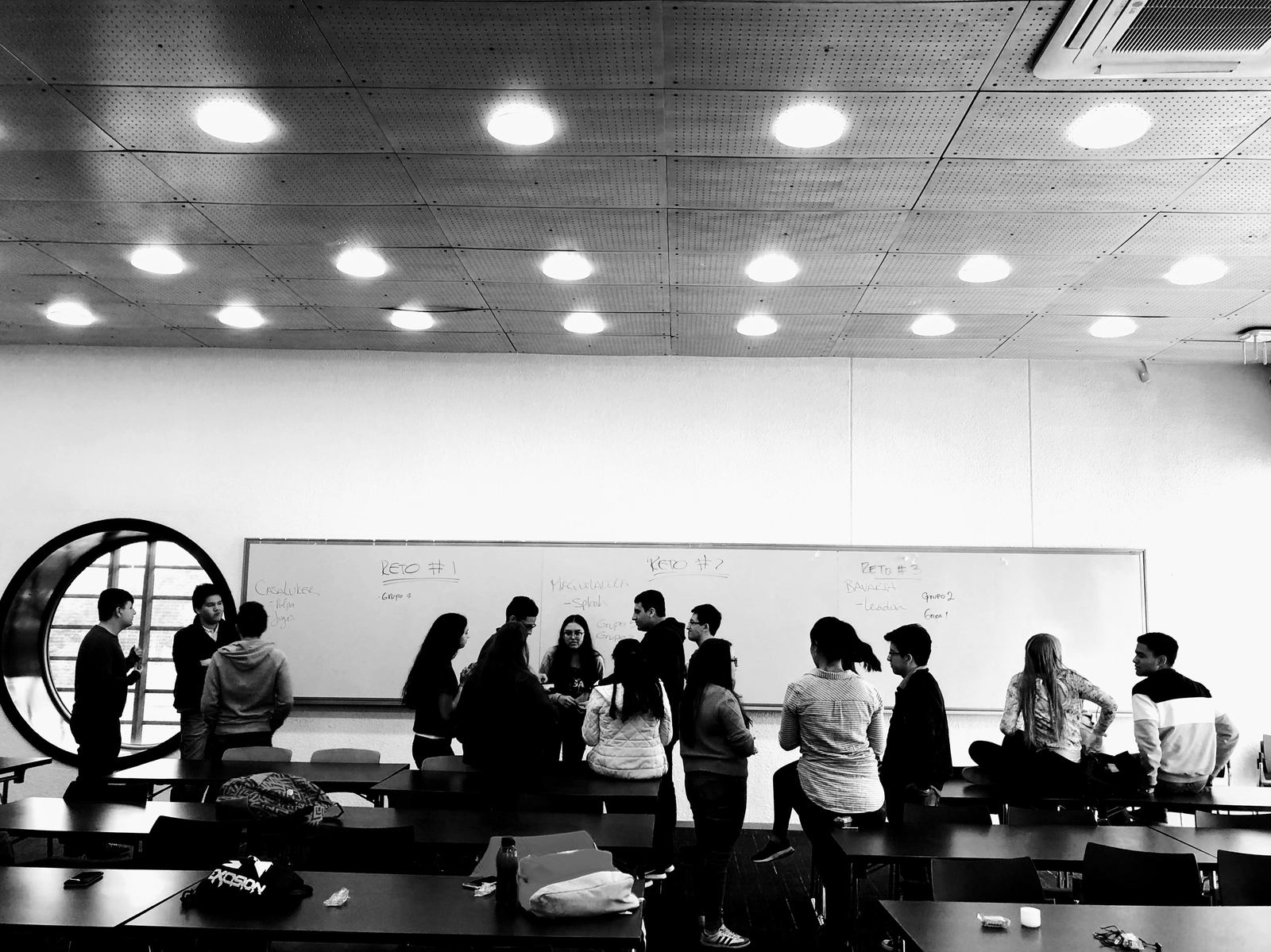
Student teams solve a real problem for a company, tied to a Sustainable Development Goal, with one advisor from the university and one from the company, and defend their solution before a jury. As in every course of our department that has a project, they work with Integrated Product and Process Design (DIPP, from its Spanish name), the design philosophy of the Department of Chemical and Food Engineering. Each semester is a different edition, and we studied the course in the 2020 article.
The editions of the Chemical Engineering Challenge
Cocoa pulp and juice with Sucesores de José Jesús Restrepo & Cía. S.A. (Casa Luker), yeasts with Bavaria & Cía. S. C. A. (Bavaria), a cosmetic formulation with a contract manufacturer, and whey
Protein in milk with Productos Naturales de la Sabana S.A.S. BIC (Alquería), an adhesive made from Bavaria’s trub, and surfactants with Loraine Cosmetics
Belcorp Edition, with Bel Star S.A. (Belcorp)
Brewing edition, with craft breweries
- 2020-20
Multidisciplinary Design Project in Engineering
IING-3000 · Redesigned in 2020-20 with Óscar Álvarez and Diego Pradilla
A School of Engineering course that Juan Carlos Briceño and Carola Hernández created in 2017. In 2020-20 I coordinated it with Óscar Álvarez. It ran online because of the pandemic, in three phases (opportunity, creativity and innovation), and the teams presented their solutions to companies.
- 2021-20
Integrated Project 2
IQUI-2032 · IQYA-2032 · Created in 2021-20
It came with the School’s curriculum reform: unit operations taught through projects, with up to 86 students per group. Its story is told on the Unit Operations page.
- 2022-10
Professional Development Project Seminar
IQUI-3094 · IALI-3094 · IQYA-3050 · Created in 2022-10 with Diego Pradilla
Alicia Porras helped us, and since 2024-20 I teach it alone. It is a one-credit course in which each student, with a mentor, turns an innovation challenge or a research question into the proposal for their professional development project. The deep work happens with the mentors; I organize the deliverables and teach the sessions on design tools, artificial intelligence, ethics and visual narratives.
From the first semester the proposal goes through the School’s ethics committee, and over the semesters the value proposition, the flowchart, the mentor’s signature on each deliverable, the Research Ethics certificate and the AI Assessment Scale (AIAS) were added. It had 11 students in 2023-10 and has 31 in 2026-20. Its semesters as IQYA-3050 have no evaluation on record: the system requires a minimum number of responses.
- 2023-20
ChemFood Challenge
IQYA-3602 · Created in 2023-20 with Óscar Álvarez
We created it after the Belcorp edition of the Chemical Engineering Challenge. Its Chr. Hansen Edition had two guided challenges, “Mi primer queso” (my first cheese) and “El yogurt”, and two dairy product challenges, with sessions taught by Chr. Hansen Colombia S.A.S. It ran one semester, with 24 students.
- 2024-10
Unit Operations Project
IQYA-2031 · Created in 2024-10
The course took this name and this code in 2024-10, and in 2025-20 I changed it from the ground up: a flipped classroom and a plant that the teams design across seven modules. For this course I received the 2026 award for innovation in chemical engineering education of the American Institute of Chemical Engineers (AIChE).
Biotechnology and bioprocesses.
- 2018-20
From yeast to beer: The scientific principles of brewing
IQUI-3518 · IALI-3101 · Created in 2018-20
Since 2021 it has also run as IALI-3101, for Food Engineering. From the first version, industry and alumni were in the classroom: Bavaria replicated the beers of the second project and the final was a sensory panel at Bar Corona; Julián Becerra, co-founder of Cervecería Moonshine S.A.S. (Moonshine), and Camilo Rojas, of Chelarte S.A.S. (Chelarte), both chemical engineering graduates, gave talks, and the first project was to replicate Chelarte’s Cerveza Raquel. Each team designs a beer, with its brand, its formulation and its process, following DIPP, and presents it to a jury.
In 2021 I made it an eight-week course graded only on the project, with two iterations of the home-brewed beer and a presentation by roles, and in 2022-10 it had 59 students and six breweries on the schedule.
- 2019-10
Industrial Biotechnology
IQUI-4230 · IQYA-4100 · Created in 2019-10
A master’s elective. The first version had exams, case studies, article summaries and a bioethics session. The second, in 2020-10, brought debates on ethical dilemmas and a home laboratory in which students built their own fermenter with bottles, hoses and a drill. In 2023-20 I taught it with the Department of Biological Sciences, under a double code (CBIO-4339) and with María Francisca Villegas, around recombinant proteins. In 2025-10 a review article written in English came in, and in 2026-10 generative artificial intelligence, with a workshop and its use to structure that article.
Its evaluation changes with who takes it. When half or more of the group are graduate students, from Chemical or Biomedical Engineering or the Sciences, it has scored 158 and 160; when about two in three are undergraduates, 152, 141 and 137. In 2026-10 the course also had three exams worth 55 % of the grade and no longer had a laboratory. It is a master’s course, I keep teaching it as one, and I teach it again in 2027-10.
Share of graduate students in each group of Industrial Biotechnology, with the course evaluation, from the most graduate-heavy group to the least. In 2023-20 both codes of the course are counted, IQYA-4100 and CBIO-4339. The vertical mark is half. - 2019-10
Systemic Design of Bioproducts
DPRO-4300 · Redesigned in 2019-10
A required course of the Master’s in Product and Process Design, taught intensively: eight weeks in three blocks of Thursdays and Fridays. Until 2022 it was an in silico molecular project: each team improved an enzyme, wrote in Authorea and ran virtual labs in Labster, and in 2022-10 presented its value proposition on a poster and a paper prototype. That semester I taught it online. I could not be at the university for personal reasons, and the Department was considering offering the master’s online, so we took it as a trial. The students did not like it.
Since 2023 I have given more weight to theoretical understanding, with a short exam at the end of each day and topics of ethics, sustainability and regulation, and since 2024-10 I teach it with Andrés Fernando González Barrios. In 2026-10 we redesigned it by scales (molecule, cell, bioprocess, techno-economics and scale-up), with tools such as AlphaFold 3, Boltz-2, GROMACS and COBRApy, and with the course’s first policy on the use of AI.
- 2020-20
Fundamentals of Bioproduct Design
IQUI-3520 · Created in 2020-20
The undergraduate version of the Systemic Design project, entirely in silico because of the pandemic, with creativity sessions, a value proposition, guests and an expert panel. I taught it one semester, to 27 students.
- 2024-10
Food Microbiology
IQYA-3012 · Redesigned in 2024-10
What was new were the MicroBlogs Alimentarios, four opinion columns across the semester; the first, “Voces de la MicroCocina”, asks students to explore how microorganisms have shaped Colombian cuisine.
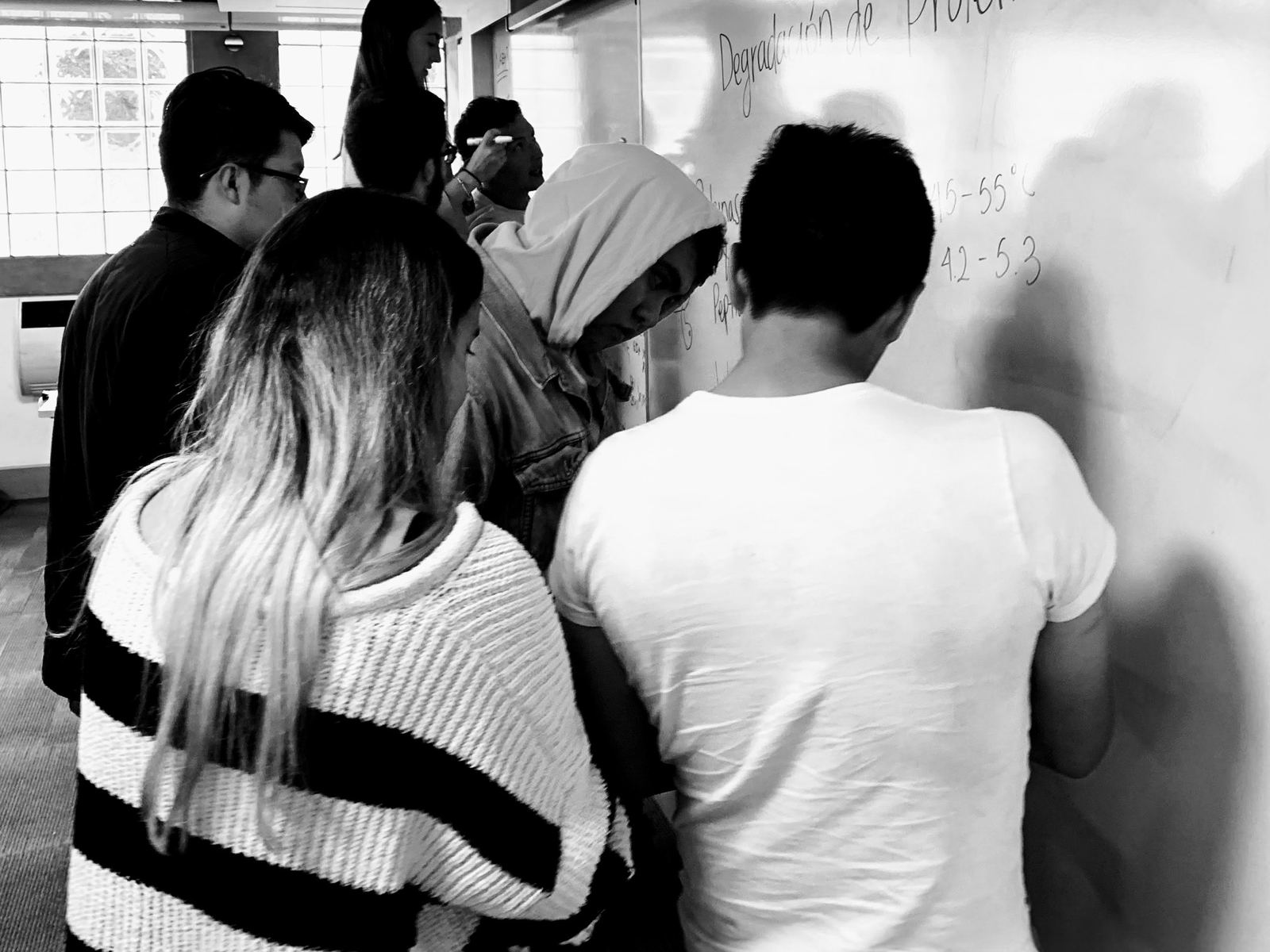
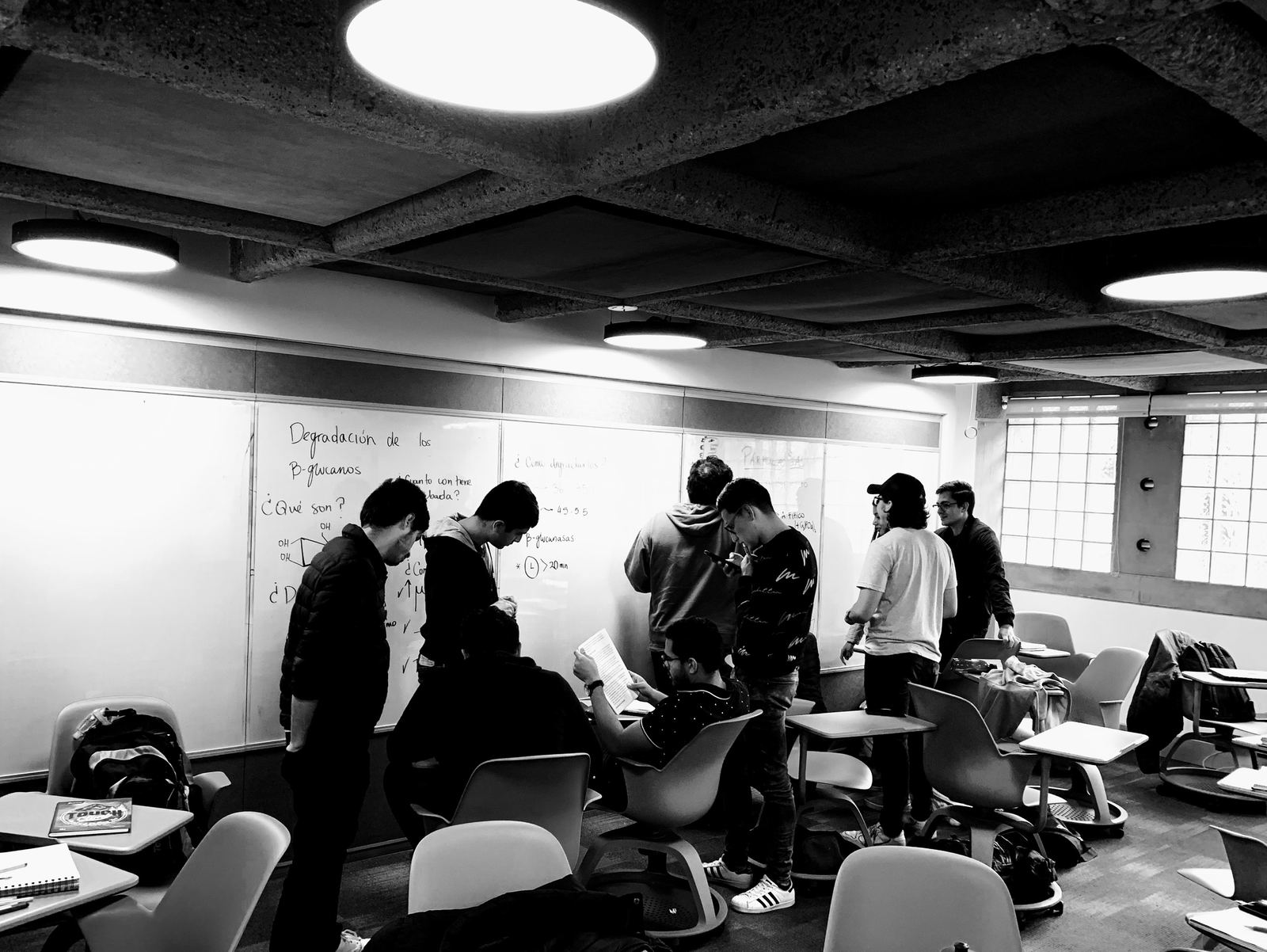
From yeast to beer. The teams explain the stages of mashing on the board, such as the breakdown of proteins, with its temperature and pH (left), and that of β-glucans (right).
General education.
- 2017-20
Experimental Design in Chemical Engineering
IQUI-2200 · Redesigned in 2017-20
I redesigned it when I arrived, in 2017, and taught it two semesters to 108 students. It had experiments at home, a project each student chose and a session on bias in research.
- 2021-20
Pandora’s Lab: From “Eureka!” to disaster
CBP-C1320 · Created in 2021-20 with Juan Carlos Cruz
A course of the Ciclo Básico Uniandino, the university’s core curriculum, in its Scientific Thinking area, open to students of every major. It starts from Pandora’s Lab, Paul A. Offit’s book on the times when science done badly or misunderstood had terrible consequences, and it borrows the book’s name with his permission. The course works on critical thinking through those cases, so that students think about the social, health and ethical problems that technologies such as artificial intelligence, gene editing, stem cells or transhumanism can bring. Each semester has conversations, debates and seven sessions with guests, and since 2025-20 artificial intelligence is one of the course’s cases. In five semesters it has taken 168 students.
Artificial intelligence.
- 2025-20
Generative AI Applications in Engineering Project Management
MGI-4307 · Created in 2025-20 with Juan Carlos Cruz
An online elective of the Master’s in Engineering Management: eight weeks, with one live session a week, that uses content from our open course on Coursera, Fundamentos del uso de IA Generativa. It has had two cohorts, of 45 students in 2025-20 and 49 in 2026-20, and it has no evaluation on record.
Every section.
Every section I have taught at Universidad de los Andes since 2017, with its students and its evaluation.
Generative AI Applications in Engineering Project Management
Elective · Graduate · 49 students
No evaluation on record
Unit Operations Project
Core · Undergraduate · 29 students
Evaluation 155
Industrial Biotechnology
Elective · Graduate · 16 students
Evaluation 137
Systemic Design of Bioproducts
Core · Graduate · 16 students
No evaluation on record
Professional Development Project Seminar
Core · Undergraduate · 19 students
No evaluation on record
Generative AI Applications in Engineering Project Management
Elective · Graduate · 45 students
No evaluation on record
Pandora’s Lab: From “Eureka!” to disaster
CBU · Undergraduate · 37 students
Evaluation 157
Unit Operations Project
Core · Undergraduate · 32 students
Evaluation 156
Professional Development Project Seminar
Core · Undergraduate · 22 students
No evaluation on record
Systemic Design of Bioproducts
Core · Graduate · 23 students
Evaluation 155
Industrial Biotechnology
Elective · Graduate · 7 students
Evaluation 158
Professional Development Project Seminar
Core · Undergraduate · 18 students
No evaluation on record
Pandora’s Lab: From “Eureka!” to disaster
CBU · Undergraduate · 37 students
Evaluation 158
Unit Operations Project
Core · Undergraduate · 16 students
Evaluation 149
Food Microbiology
Core · Undergraduate · 4 students
Evaluation 154
Professional Development Project Seminar
Core · Undergraduate · 14 students
No evaluation on record
Systemic Design of Bioproducts
Core · Graduate · 18 students
Evaluation 155
Unit Operations Project
Core · Undergraduate · 24 students
Evaluation 149
Food Microbiology
Core · Undergraduate · 21 students
Evaluation 155
Professional Development Project Seminar
Core · Undergraduate · 12 students
No evaluation on record
Pandora’s Lab: From “Eureka!” to disaster
CBU · Undergraduate · 36 students
Evaluation 158
Integrated Project 2
Core · Undergraduate · 18 students
Evaluation 152
ChemFood Challenge
Elective · Undergraduate · 24 students
Evaluation 160
IQUI Special Project
Elective · Undergraduate · 2 students
Evaluation 153
Industrial Biotechnology
Elective · Graduate · 17 students
Evaluation 141
Professional Development Project Seminar
Core · Undergraduate · 12 students
No evaluation on record
Chemical Engineering Challenge
Elective · Undergraduate · 27 students
Evaluation 157
Integrated Project 2
Core · Undergraduate · 29 students
Evaluation 143
Systemic Design of Bioproducts
Core · Graduate · 15 students
Evaluation 153
Professional Development Project Seminar
Core · Undergraduate · 11 students
No evaluation on record
Industrial Biotechnology
Elective · Graduate · 26 students
Evaluation 152
Professional Development Project Seminar
Core · Undergraduate · 38 students
Evaluation 157
Integrated Project 2
Core · Undergraduate · 36 students
Evaluation 135
Pandora’s Lab: From “Eureka!” to disaster
CBU · Undergraduate · 27 students
Evaluation 158
Professional Development Project Seminar
Core · Undergraduate · 2 students
Evaluation 151
Professional Development Project Seminar
Core · Undergraduate · 50 students
Evaluation 155
Thesis Project Seminar
Core · Undergraduate · 8 students
Evaluation 156
Integrated Project 2
Core · Undergraduate · 79 students
Evaluation 143
From yeast to beer: The scientific principles of brewing
Elective · Undergraduate · 59 students
Evaluation 154
Professional Development Project Seminar
Core · Undergraduate · 5 students
Evaluation 141
Systemic Design of Bioproducts
Core · Graduate · 30 students
Evaluation 140
Industrial Biotechnology
Elective · Graduate · 13 students
Evaluation 160
Integrated Project 2
Core · Undergraduate · 86 students
Evaluation 141
Pandora’s Lab: From “Eureka!” to disaster
CBU · Undergraduate · 31 students
Evaluation 157
Chemical Engineering Challenge
Elective · Undergraduate · 14 students
Evaluation 159
Unit Operations
Core · Undergraduate · 36 students
Evaluation 153
From yeast to beer: The scientific principles of brewing
Elective · Undergraduate · 10 students
Evaluation 159
Unit Operations
Core · Undergraduate · 49 students
Evaluation 152
Multidisciplinary Design Project in Engineering
Elective · Undergraduate · 38 students
Evaluation 152
Fundamentals of Bioproduct Design
Elective · Undergraduate · 27 students
Evaluation 154
Systemic Design of Bioproducts
Core · Graduate · 21 students
No evaluation on record
Industrial Biotechnology
Elective · Graduate · 16 students
No evaluation on record
Chemical Engineering Challenge
Elective · Undergraduate · 17 students
No evaluation on record
Unit Operations
Core · Undergraduate · 56 students
No evaluation on record
Unit Operations
Core · Undergraduate · 75 students
Evaluation 152
From yeast to beer: The scientific principles of brewing
Elective · Undergraduate · 25 students
Evaluation 162
Systemic Design of Bioproducts
Core · Graduate · 11 students
Evaluation 158
Unit Operations
Core · Undergraduate · 68 students
Evaluation 153
Chemical Engineering Challenge
Elective · Undergraduate · 21 students
Evaluation 163
Industrial Biotechnology
Elective · Graduate · 26 students
Evaluation 159
Unit Operations
Core · Undergraduate · 50 students
Evaluation 153
From yeast to beer: The scientific principles of brewing
Elective · Undergraduate · 30 students
Evaluation 161
Experimental Design in Chemical Engineering
Core · Undergraduate · 58 students
Evaluation 156
Unit Operations
Core · Undergraduate · 68 students
Evaluation 154
Experimental Design in Chemical Engineering
Core · Undergraduate · 50 students
Evaluation 154
Unit Operations
Core · Undergraduate · 21 students
Evaluation 160
Evaluation is the overall score students gave that section. A dash means the section has no evaluation on record: 2020-10 had none because of the pandemic, the seminar as IQYA-3050 does not reach the minimum number of responses, and the master’s elective in engineering management has none on file.
My teaching evaluation.
The University gives each professor an overall teaching evaluation score every semester. I do not compare mine with the Faculty average, which depends on too many factors. The figures are readings of the system’s charts, which do not show the numbers, and may be off by one point.
Until 2021-10 it stayed around 156. Between 2021-20 and 2024-10 it fell to about 150, and between 2024-20 and 2025-20 it went back to 155. In 2026-10 it was 146, because of Industrial Biotechnology; that same semester, the Unit Operations Project scored 155.
2026-10 · 146Touch a point to read its semester and score.
My overall evaluation for each semester, with its three stages. 2020-10 had no evaluation, because of the pandemic.
What each drop taught me.
- 2021-20 and 2022-10
Integrated Project 2
Evaluation 141 · 143
With the reform the course became project-based, with up to 86 students per group and no assessed theory. The theory came in training sessions that not every team member took, and the students asked for more guidance.
A project course also needs guided theory. From 2022-20 I gave it back: first weekly videos with quizzes, and in 2023-20 assessed workshops and guided labs.
- 2022-20
Integrated Project 2
Evaluation 135
It was the first semester of that adjustment, and the new design was still settling.
I kept adjusting it, and the evaluation rose to 143, 152, 149, 149, 156 and 155.
- 2022-10
Systemic Design of Bioproducts
Evaluation 140
I taught it with online classes, as a trial.
I went back to the classroom and gave more weight to theory: 153, 155 and 155.
- 2022-10
Professional Development Project Seminar, Food Engineering section
Evaluation 141
Five students, in the first semester of the course. The Chemical Engineering section scored 155.
With five responses the figure says little on its own, and I kept the course as it was.
- 2023-20 and 2026-10
Industrial Biotechnology
Evaluation 141 · 137
About two in three students were undergraduates, in a master’s elective, and in those two semesters the course also had three exams.
I keep it as a master’s course, and I teach it again in 2027-10.