Unit Operations.
Three courses for one purpose: teaching unit operations. Each change came from what the previous one left unresolved.
Recognized by AIChE in 2026.
Award for Innovation in Chemical Engineering Education, AIChE Education Division.
In 2026 the Education Division of the American Institute of Chemical Engineers (AIChE) gave me its award for innovation in chemical engineering education for this course. Every earlier winner on its list, which starts in 2014, was a professor at a university in the United States. It is presented on 10 November 2026 at the AIChE Annual Meeting, in Minneapolis.
The award page lists it as “Integrating generative AI into chemical engineering education through project-based unit operations”.
The evaluation of the three courses.
Each point is the evaluation of one semester of the course, with the articles, the 2025-20 redesign and the award marked above. Touch a point to read its semester and score.
2026-10 · Unit Operations Project (IQYA-2031) · 155
Evaluation of Unit Operations (IQUI-3010), Integrated Project 2 (IQUI-2032 and IQYA-2032) and the Unit Operations Project (IQYA-2031).
Three courses.
- 2017 to 2021
Unit Operations
IQUI-3010
I received it as a classic lecture course and began with a diagnosis: 91 % of the students described the workload as high or very high, and they lived the course apart from Modeling and Simulation, although both solve the same balances. With Nicolás Ríos Ratkovich, the graduate assistants and the support of the Center for Innovation in Technology and Education (Conecta-TE), with Diana Cortés on pedagogy and Alexandra Ramírez on technology, we redesigned it over four semesters: the diagnosis, the pilot of one module (2017-20), the pilot of the whole course (2018-10) and an implementation without the center’s support (2018-20).
That first version, which I called 1.0 on the course map, had a flipped classroom with moments at home, in class and after class, supported by an e-book of seven modules, videos and a forum for questions to the professor, and a joint project with Modeling and Simulation in which the teams designed, 3D-printed and characterized a centrifugal pump inside a 12 cm cube, at 750 rpm. In 2018-10 there was also a shell-and-tube heat exchanger tested in the laboratory. We added the teamwork tools as conflicts appeared: peer and self-assessment, the team contract and follow-up minutes.
We followed it with interviews, focus groups and two surveys per semester. Students’ perception of their technical skills improved with statistical significance between the pilot and the full implementation, and 85 % valued the pump project. The two articles also say what did not work: the 2019 one found the project narrow and unconnected to other topics of the course, such as distillation; the 2021 one, that peer discussions were still shallow and that this limited complex thinking.
In 2020-10 I built version 2.0: a project-oriented, problem-based course with Integrated Product and Process Design (DIPP), a type E writing course with the support of the Centro de Español, with mini-challenges, ethical considerations, roles of product specialists and games such as a treasure hunt with prizes. That semester the course was project only, with no exams, and in 2020-20 and 2021-10 I gave it back eight weeks of theory with workshops and two exams.
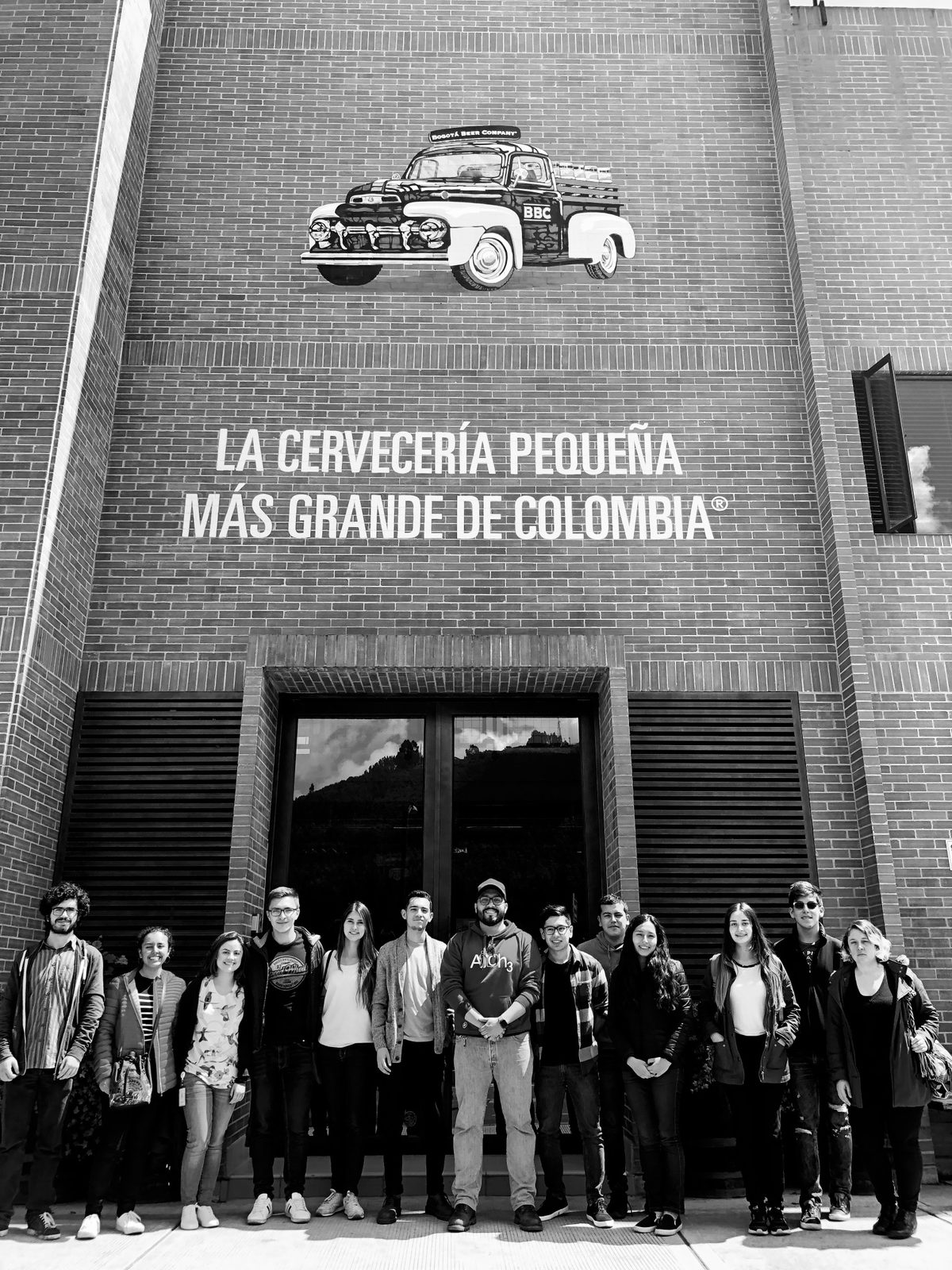
Unit Operations technical visit to Bogotá Beer Company (BBC). - 2021 to 2023
Integrated Project 2
IQUI-2032 · IQYA-2032
With the School’s curriculum reform, the course became Integrated Project 2, with up to 86 students per group. Its first version had no assessed theory: it came in training sessions that not every team member took, and each student was expected to read it on their own. Students were not used to working that way and asked for more guidance, and the evaluations fell to 141 and 143.
From 2022-20, with Conecta-TE again, now with Sandra Milena Escobar on pedagogy and Daniel Santamaría on technology, I gave the theory back, first with weekly videos and quizzes. That semester was the lowest, at 135. In 2023-20, the last semester under that name, the course moved to a project that runs through the whole semester, in a fictional industrial setting that changes every semester, with complementary theory sessions, assessed workshops and guided labs. That semester students began to use generative artificial intelligence, governed by the AI Assessment Scale (AIAS) in the course guides, and the evaluation rose to 152.
- Since 2024
Unit Operations Project
IQYA-2031
In 2024-10 the course took this name and the code IQYA-2031, kept the same project and added a points system with a leaderboard. Since 2024-20 the AIAS has been part of the syllabus. In those two semesters it scored 149.
In 2025-20 I changed it from the ground up. Today the course is a flipped classroom, with my own readings before class since 2026-20 (before that, podcasts), and the project is a plant that the teams design across seven modules of unit operations, with calculation logbooks, simulation in Aspen Plus checked against hand calculations and the AIAS assigned activity by activity. The fictional company, the flyer and the points went out. The plant made alcohol in 2025-20 and 2026-10, and in 2026-20 it makes pectin from citrus and passion fruit peels, with the product and DIPP back in. With that design the course had its two highest evaluations, 156 and 155.
In 2025-20 David Santiago Ramos, an undergraduate I advised, built a multi-agent system that supports the same design methodology in his professional development project.
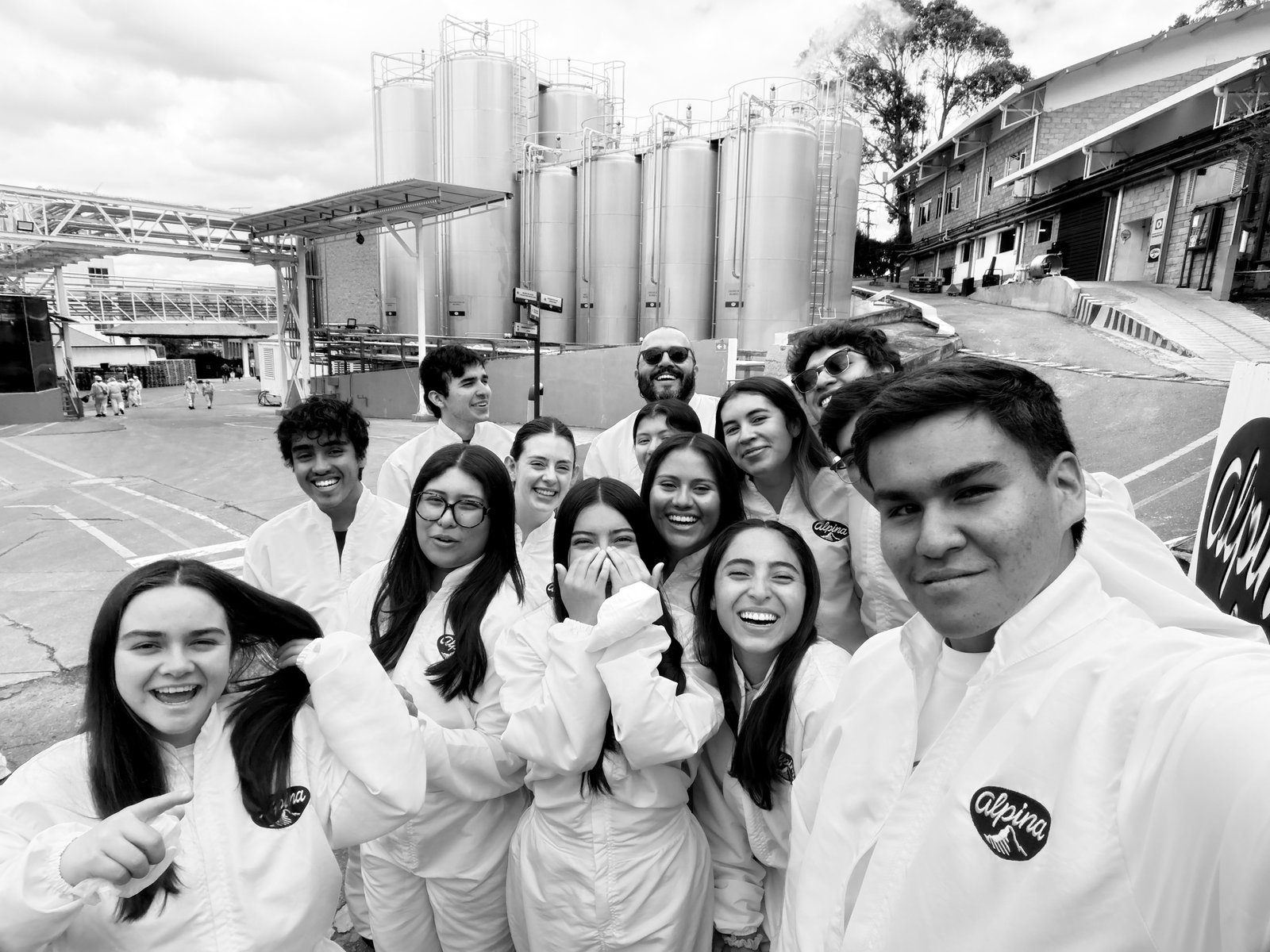
The Unit Operations Project class on a technical visit to a plant of Alpina Productos Alimenticios S.A.S. BIC, 2026.
The 2025 study.
We studied four consecutive semesters, from 2022-20 to 2024-10, with surveys, performance metrics and thematic analysis of the open answers, and published it in 2025. Olga Lucía Acuña and Deya Marcela Santos Carvajal are the first authors, with equal contribution, and Angie Bolaños, Julian Torres, Óscar Álvarez and Juan Carlos Cruz also sign it. Written and visual communication improved with statistical significance from semester to semester.
Since AI came in halfway through the period, we compared the literature reviews of the semesters without AI with those of the semesters with AI. So that my own grading would not bias the comparison, an independent evaluator re-graded, with the same rubric, the written communication of documents from different semesters. The article acknowledges in its abstract that there were implementation difficulties, and that comparison across cohorts comes closest to the causal study I still lack: it suggests an effect, but does not prove it.
The study in figuresThe course today.
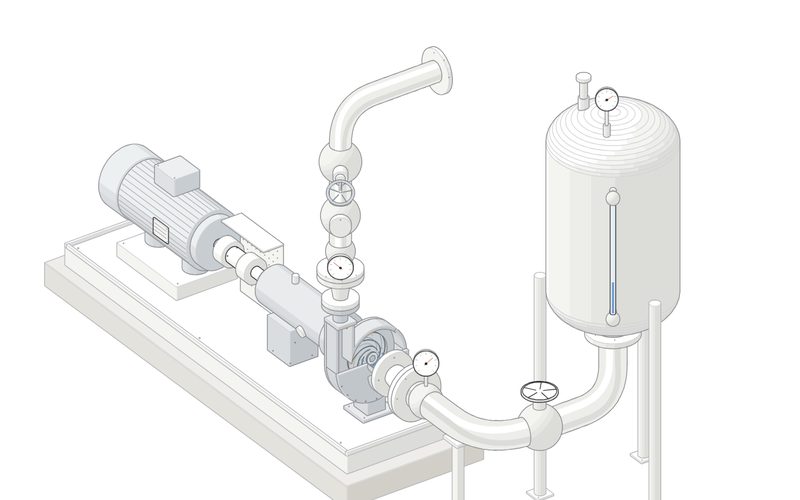
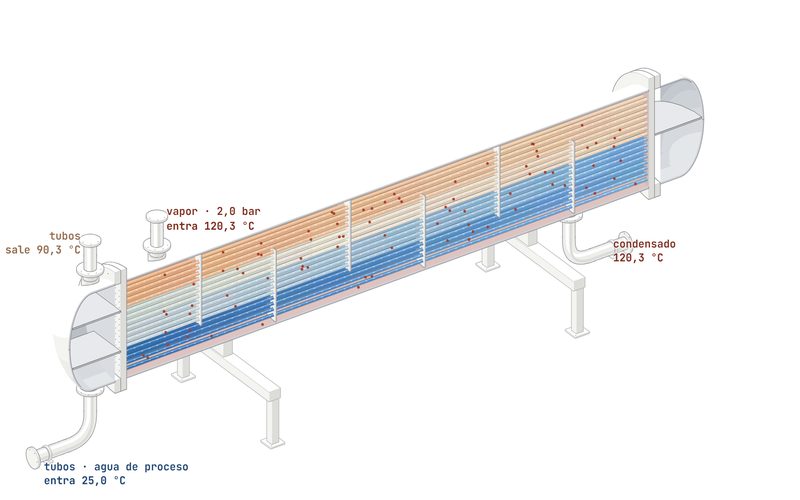
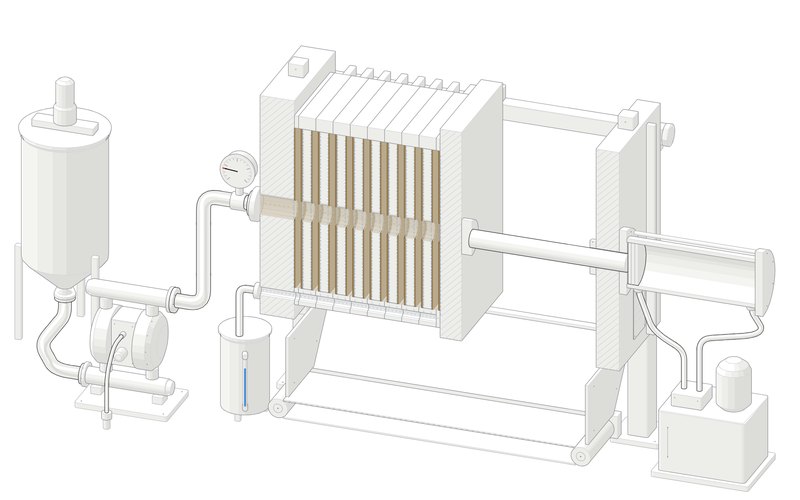
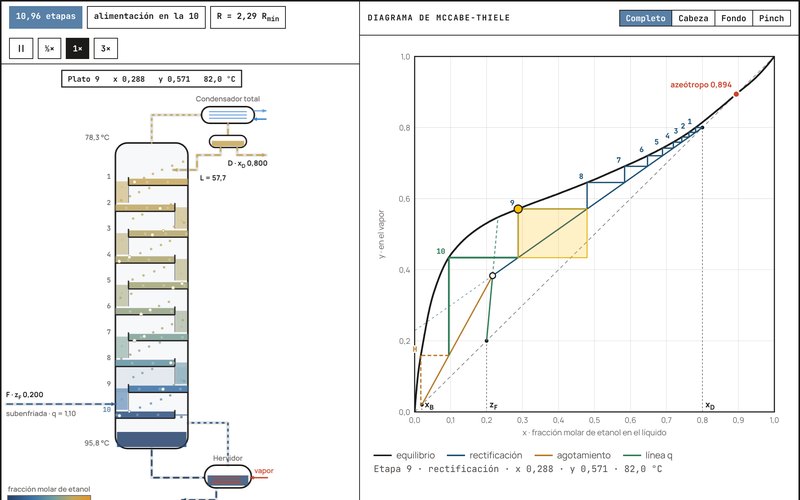
In 2026-20 the course classroom on this site has 12 simulators and a manual of engineering diagrams, from milling and pumps to heat exchangers and distillation. Four of them, as students see them:

Two students of the course.

“I had the opportunity to work with Professor Luis H. Reyes in various academic settings: first as his student in the Unit Operations course and later as a graduate assistant. In each of these contexts, the professor distinguished himself by his creativity and the constant generation of valuable ideas, which enriched both learning and academic development.”

“I had the opportunity to take the Unit Operations and Industrial Biotechnology courses with Professor Luis H. On both occasions, he proved to be an excellent teacher, combining a deep knowledge of the subject with a dynamic and innovative teaching methodology. From including current topics as case studies to examples from various disciplines that showed the interrelation of knowledge and the versatility of engineering to be applied in different fields, his way of teaching was always enriching. He even implemented novel methods for exams, such as the Jeopardy format, and always maintained an 'open door' policy to clarify students' specific doubts. All this made it so that, even seven years later, I can affirm that it was one of the lessons I internalized the most during my time at the university.”
The three articles.
- 2019Applying PBL methodologies to the chemical engineering courses: Unit operations and modeling and simulation, using a joint course project
Ballesteros, M.A., Daza, M.A., Valdés, J.P., Ratkovich, N., & Reyes, L.H.
Education for Chemical Engineers, 27, 35-42. doi:10.1016/j.ece.2019.01.005
- 2021Modernizing the chemical engineering curriculum via a student-centered framework that promotes technical, professional, and technology expertise skills: The case of unit operations
Ballesteros, M.Á., Sánchez, J.S., Ratkovich, N., Cruz, J.C., & Reyes, L.H.
Education for Chemical Engineers, 35, 8-21. doi:10.1016/j.ece.2020.12.004
- 2025Fostering technical proficiency and professional skills: A multifaceted PO-PBL strategy for unit operations education
Acuña, O.L., Santos Carvajal, D.M., Bolaños-Barbosa, A.D., Torres-Vanegas, J.D., Alvarez Solano, O.A., Cruz, J.C., & Reyes, L.H.
Education for Chemical Engineers, 51, 64-78. doi:10.1016/j.ece.2025.01.001
The course is one case among the studies I have made of my own teaching. Research on my own teaching